
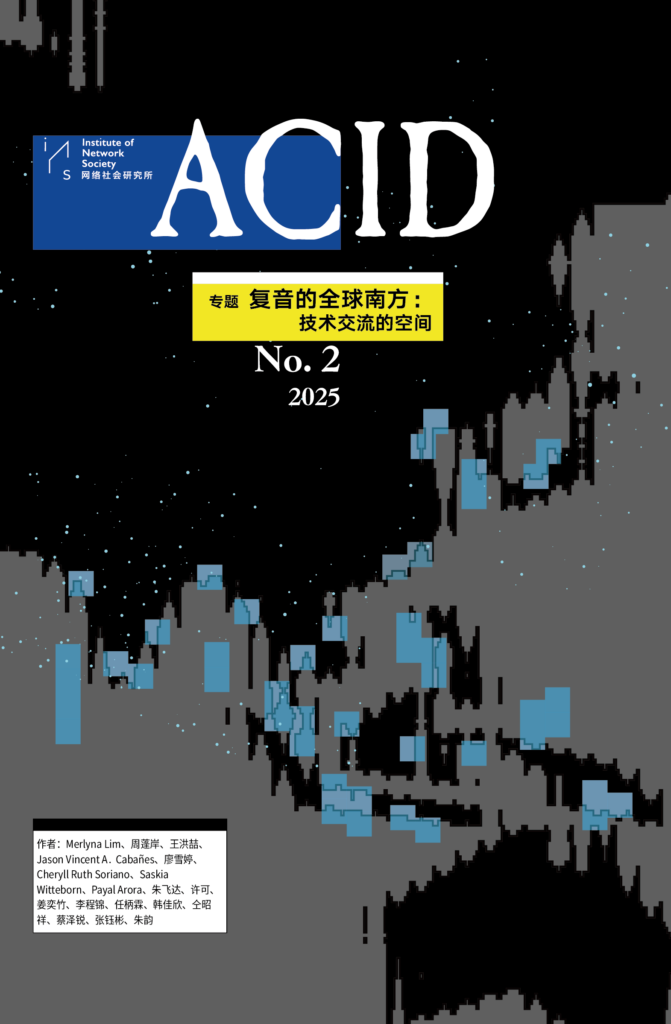
“复音的全球南方”不是地理标签,而是一种方法论。当 Balaji Srinivasan 的「网络国家」许诺以股东制取代公民权、以私人主权铲除民主协商,当矽谷修辞把 1% 的财富集中包装成「去中心化」,ACID 第二期把第九届网络社会年会选集连同一般论文放回「南方」这个复数的位置上。
这里的南方,是菲律宾的平台劳动与 Web3 田野、印度的数据偏见、深圳龙华公车站的身体,是 1960 年代韩国的技术浪漫主义、1990 年代中国的山寨文化,是科技拾荒者手上被称为「洋垃圾」的废弃电子产品。冷战与后冷战、制造现场与流动亲密、「社会性媒介」与「新地形」,被放在同一张地图上。
Merlyna Lim、Jason Vincent Cabañes、Cheryll Ruth Soriano、Saskia Witteborn、Payal Arora 与来自中国、韩国、菲律宾的年轻学者一起做的,不是把全球南方包装成抵抗的神话,而是细看”坏的数位纳入”(adverse digital incorporation)与慢性贫困如何被演算法与平台重新生产。技术从来不在政治之外。问题是,我们用谁的技术,在哪一个历史尺度上判断。(黄孙权)免费下载pdf 与 epub 档,见文后。
“Polyphonic Global South” is not a geographical label but a methodological stance. When Balaji Srinivasan’s “Network State” promises to replace citizenship with shareholding, and democratic deliberation with private sovereignty, when Silicon Valley rhetoric repackages the concentration of wealth in the top 1% as “decentralization,” ACID No.2 places the selected papers from the 9th Annual Conference on Network Society, together with general research articles, back into the plural position called “the South.”
The South here is platform labor and Web3 fieldwork in the Philippines, data bias in India, bodies at the Longhua bus terminal in Shenzhen. It is the techno-romanticism of 1960s South Korea, the shanzhai culture of 1990s China, the discarded electronics called “foreign waste” passing through the hands of tech scavengers. Cold War and post-Cold War, factory floor and mobile intimacy, “societal media” and “new terrains” are laid on a single map.
What Merlyna Lim, Jason Vincent Cabañes, Cheryll Ruth Soriano, Saskia Witteborn, Payal Arora, and emerging scholars from China, South Korea, and the Philippines do here is not to package the Global South as a myth of resistance, but to trace how “adverse digital incorporation” and chronic poverty are reproduced by algorithms and platforms. Technology has never been outside of politics. The question is: whose technology do we use, and at what historical scale do we judge. (Huang, Sunquan)
本期目录
ACID No.2 复音的全球南方
编辑手记 ix — 郑叶颖
专题引言 3 — 黄孙权
板块一:制造南方 / PANEL 1: MANUFACTURING SOUTH
情感与算法:解开社交媒体政治的数字核心 — Merlyna Lim 9
垃圾佬——以再利用作为平价电子产品的来源 — 周蓬岸 29
从技术浪漫主义到技术封建主义——中韩早期信息社会的历史比较研究 ─ 王洪喆 54
板块二:流动的联结性 / PANEL 2: MOBILE CONNECTIVITY
全球本土化亲密关系:来自全球南方的移动媒介化关系论建构 — Jason Vincent A. Cabañes 77
板块三:社会性媒介 / PANEL 3: SOCIETAL MEDIA
数字行动主义与男性权益运动的民粹主义浪潮 — 廖雪婷 99
平台、劳动与中介动态 — Cheryll Ruth Soriano 116
板块四:新地形 / PANEL 4: NEW TERRAINS
WEB3与区块链游戏:一种南方视角 — Saskia Witteborn 147
消除数据偏见以建立包容性技术 — Payal Arora 171
当人工智能遇上WEB3:共筑可持续数字经济 — 朱飞达 194
青年学者论坛 / EMERGING SCHOLARS FORUM
数字殖民主义之下的全球南方:消失的社交媒体和中国启示 — 许可 221
创新还是仿造?重思”山寨(SZ)”的转变 — 姜奕竹 李程锦 224
傅壇的游戏历程:解码手柄上的中国计算机启蒙 — 任柄霖 248
“无奋斗,不龙华”,龙华汽车站田野调查 — 韩佳欣 仝昭祥 256
一般论文 / RESEARCH ARTICLE
红色模型:中国人工智能治理的平衡与失衡 — 蔡泽锐 273
“他”的政治不是我的世界——《极乐迪斯科》女性玩家认同研究 — 张钰彬 286
技术之云与艺术之线:人工智能生态中的攫取逻辑与审美抵抗 — 朱韵 299
Acknowledgments 309
ACID #2: Polyphonic Global South: The Spaces of Technological Communication
2025 (ISSN 2960-0944)
中國美術學院網絡社會研究所 INS(ISSN 2960-0944)頁數323